 |
Officer has weapon aimed point-blank
at protestors blocking the entrance to the WTO building. Image via SeattlePI.
American Protests, peaceful and
otherwise, must be seen within the full scope of 20th Century America,
including the very months leading to the conclusion of the century and entrance
into a new millennium. The history of America, especially in the 20th Century
is marked by globalization, the gradual (or sometimes rapid) increase of the interconnectedness between people, cultures, institutions, and technological
advancements. A process that many see as mutually beneficial for all parties,
but for some, there is nothing else to experience other than a feeling of being
left behind by one’s leaders.
A lesser-known but massive protest
staged in Seattle, Washington pitted nearly 40,000 peaceful and violent
anti-globalist and anti-capitalist protestors against a new round of trade
negotiations hosted by the World Trade Organization as part of the WTO
Ministerial Conference of 1999. The
largest anti-globalist protest in US history at that point in time. Attendance
reached over 40,000.
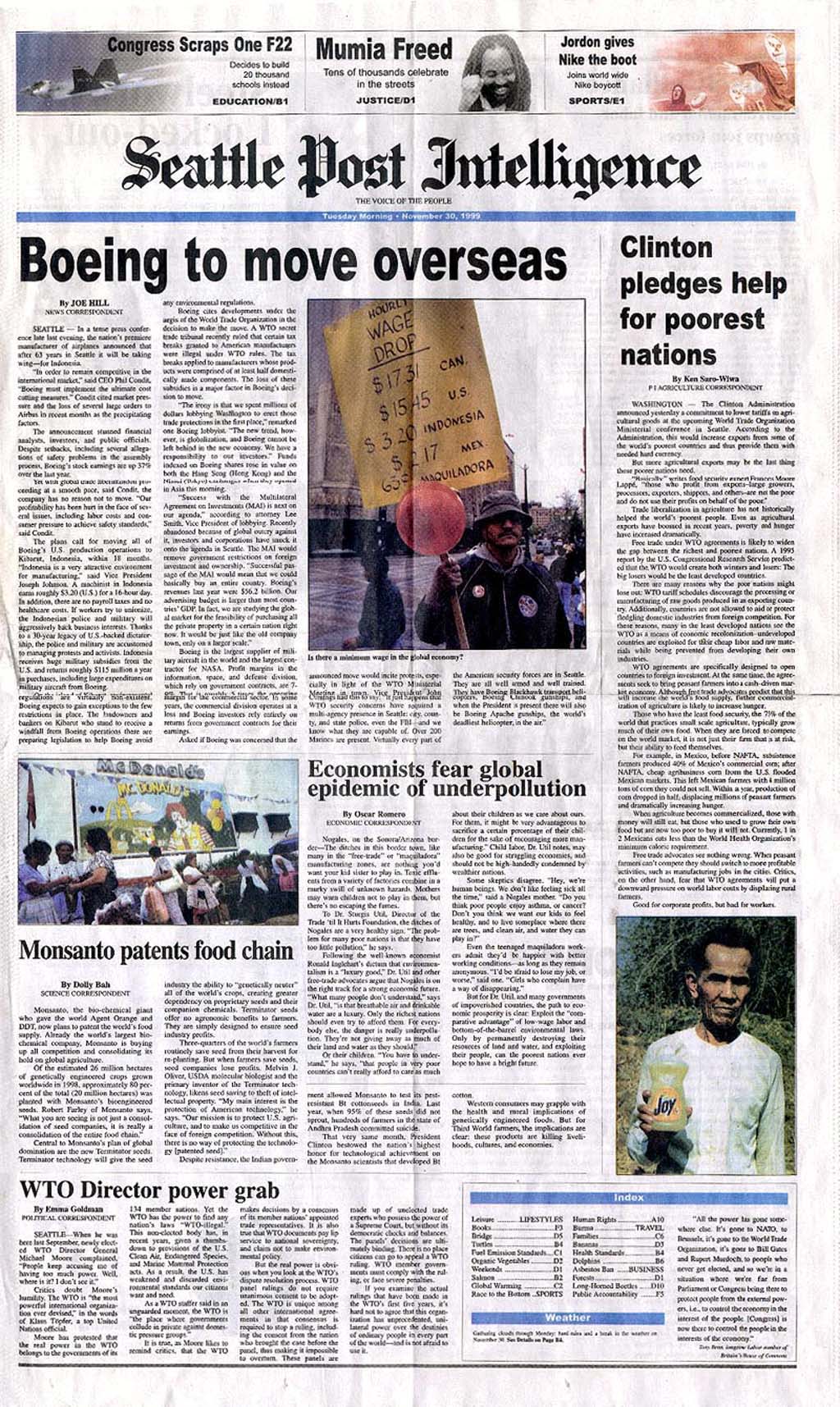
Protestors not only took to the
streets, but they also created propaganda and parody newspapers to make fun of
the WTO and the “globalist elite” they opposed. HistorLink showcases the
newspaper that focuses on parody headlines, linked here, is an artefact directly taken from
the time of the protest. A primary source from the larger event. The website,
historylink.org, is a great source for a detailed portfolio of photos concerning
the WTO protests. Some images were captured by photographers, some are screen
grabs from live video of news, and others are from security cameras. The
portfolio showcases the diversity in style of protest, the incorporation of
art, and both the peaceful and violent aspects of the protest. The full article,
entitled 1999: WTO — HistoryLink Webcam of Protests and a Slideshow
of Each Day, can be accessed here.
In many instances of protest in the United States, the line between non-violent peaceful protest, inciteful acts of
violence and provocation, and deliberate acts of violence and rioting seem to
blur. A protest or march on a specific issue such as Civil Rights may be rooted
in non-violence such as advocated by Dr. Martin Luther King Jr., nevertheless,
there is always a fringe in large protests and counter-protests that is willing
to use violence. In addition, collective action, as posited in David Strang’s article
in the American Journal of Sociology,
can diffuse the responsibility of individuals to a group making violence much easier
to justify on the individual level. The
WTO protests are particularly hard to decipher when looking at the use of
violence and the use of non-violent tactics of protests. This line, blurred or
clear, between violent and non-violent action, is exactly what calls on the
moral quandaries discussed in the papal document Gaudium et Spes. A document that focuses on the role of government
and the civil society, how this is balanced with Catholic moral teaching, and
the promotion of human dignity for all people.
 |
Protestor Jody Hutchinson shoved by Seattle police officer
on December 1st, 1999. Courtesy of SeattlePI.
Looking at the evidence of both
scholarly journal articles and media reporting on the WTO Protests, there is a
disparity in how the event is portrayed in terms of the origination of
violence, and whether the authorities or violent protestors initiated and
escalated the violence. The media coverage tends to portray the civil
authorities, such as police and riot control officers, as the initiators of
violence. Whereas the scholarly literature portrays a more nuanced view
that the evidence is not conclusive of who started the violence or even if
there is a group or “side” that initiated the violence that diverges from moral
protest outlined in Gaudium.
 |
A protestor from San Fransisco being
dragged out of the Paramount Theater, the location of the WTO negotiations in
Seattle. Image via SeattlePI.
|
To learn more about the WTO protest
of 1999 and to see additional photographs of the event you can visit the online
Seattle
Municipal Archives.

I did not realize that many protested the WTO on the basis they felt their leaders were leaving them behind. Having ties with trade around the world not only benefits the country you are from but can benefit the one you are trading with. It can create a balance between nations and helps form peace treaties. According to Gaudium as it states that if a community is torn there must be some authority to direct energies of all the citizens toward a common good to get them to act above all as a moral force which appeals to each one’s freedom and sense of responsibility. In my blog post about the ACT UP AIDS strike is similar. Those with AIDS and those who were in fear of the disease organized in many dangerous and violent riots like you portrayed in your post. The people were willing to be violent because they felt it was a way to get their voice heard.
ReplyDeleteAfter reading your article i am surprised to see that there was such a focus on the violence in such large protests. As you mentioned there was only a small fringe group of activists that would be willing to use violence to make an attempt to prove their point and air their grievances with the Government. It's also surprising to see that no matter how noble or peaceful the majority of a protest can be, the entire message can be skewed and morphed by the actions of so few choosing to act in a violent way. On the other hand, it would be interesting to see the "success rate" of protests that have had issues with violence versus the "success rate" of protests that remain prominently peaceful. I personally think that a protest that has an element of violence to it tends to grab much more attention from the media since we are so tuned into the presence of violence and we are all drawn to it. Which would increase the number of people watching the developments of the protest. However the presence of violence can also delegitimize the main idea of a protest and could have a counter productive effect on the protest
ReplyDelete